Category: Advice

  • How to test candidate commitment

    How to test candidate commitment

    It’s important to ensure that candidates are fully committed to the hiring process. No one wants to be messed around, so establishing if a candidate is truly keen to find a new role or not early on is vital. 

    If money is their only motivator they might just be after a counteroffer from their current employer. So figure out their motivators early on.

    Here are some tips on how to test candidate commitment:

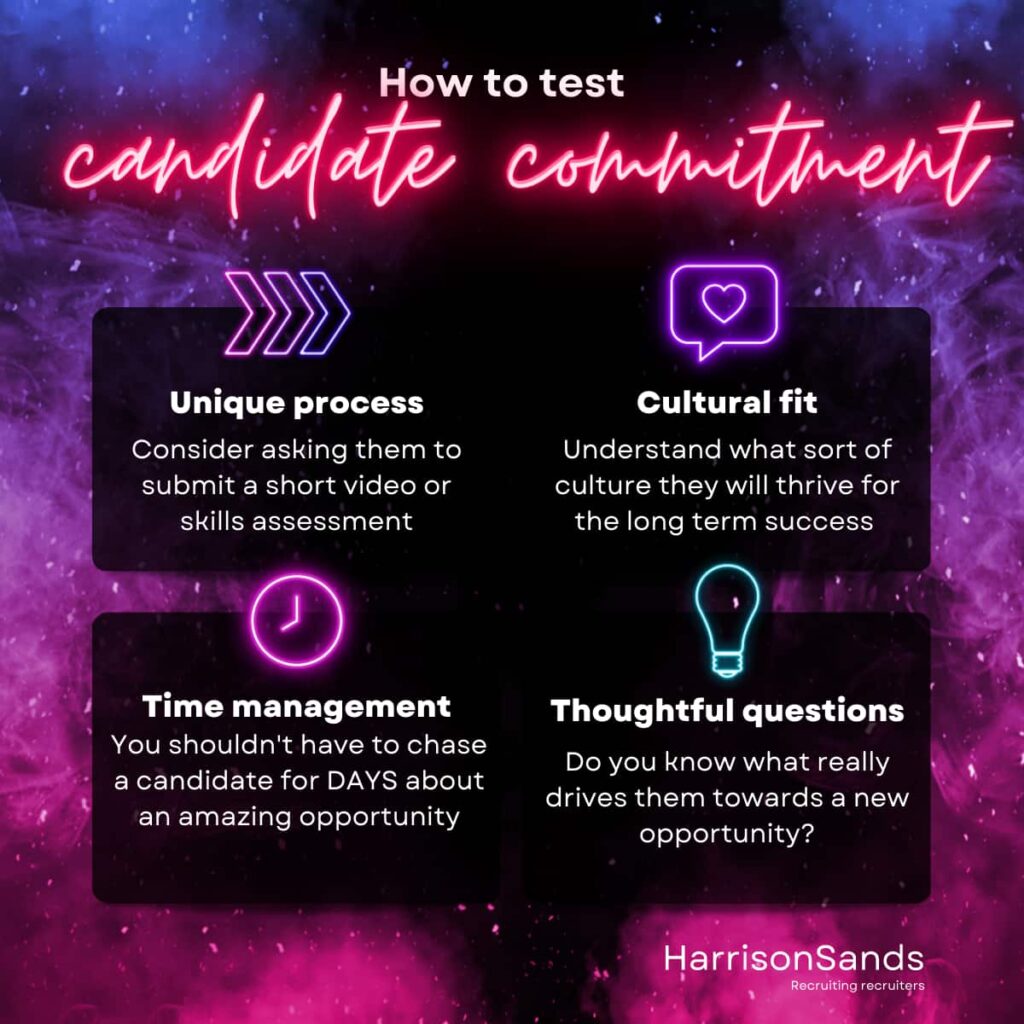
    🕑 Time Management – Observe how quickly candidates manage their time with you and respond to communication. If they are taking DAYS to come back to you, it’s likely they’re not serious about looking for a new role. Everyone is busy but everyone can take 5 minutes for a quick email or call if it’s a priority.

    📝 Unique Application Process – Consider implementing a unique application process to test candidate commitment. For example, asking candidates to submit a short video introducing themselves or completing a skills assessment can help weed out candidates who aren’t fully invested in the position.

    👥 Cultural Fit – Understand what sort of culture the candidate will thrive best in. Ask them directly, don’t guess. They should know what sort of environment they work best in and what culture they need to work in to enjoy their working day as well as work effectively in the long term.

    💬Thoughtful Questions – Ask thought-provoking questions to gauge their commitment. For example, asking a candidate about their long-term career goals and how this position fits into those goals can help determine if they’re fully committed to a new role.

    🔍  Preparation for Interviews – A committed candidate will have taken the time to research the company and the position they are applying for. They should be able to articulate why they are interested in the role and how their skills and experience make them a good fit. Look for thoughtful questions that demonstrate their interest in the company and the role.

    💯 Commitment to the Hiring Process – A committed candidate will follow through with all stages of the hiring process, not just the initial stages. They should be willing to attend all interviews and assessments and complete any required paperwork in a timely manner. This shows that they are serious about pursuing the opportunity and are committed to the process.

    Finding the right candidate can be difficult, but it’s worth it in the end. Making sure that candidates are genuinely motivated and committed to their job search is key to finding someone who will stay for the long term and contribute to your client’s success.

    By taking the time to test commitment levels, you’ll save yourself valuable time by avoiding the wrong candidates and finding the perfect fit for your role. 

    Investing in skills tests and asking insightful questions of potential candidates can help you get the most out of your recruitment process.


  • How to build your credibility on LinkedIn

    How to build your credibility on LinkedIn

    Are you a recruiter with a tight job board budget? Looking for ways to increase your visibility and build credibility? LinkedIn is the place to be.

    We’ve actually made placements off the back of recruiters engaging with polls! 🤯

    At first, it might seem like LinkedIn is a vanity project – but if you put in the effort, it can absolutely work for you. Stay up-to-date on the trends every week and watch what’s working and what’s not.

    Be authentic in your posts by thinking about what you ACTUALLY think. Avoid jumping on popular topics just because they’re trendy. Instead of going viral, focus on building your personal brand and use that voice! Then be consistent. Consistency is key and is so overlooked.

    Remember: LinkedIn is a networking site and when you regularly post, people will come to you. Post content that engages with topical posts that week, share knowledge, tell stories, and ask questions. You’ll get more likes, comments, and followers if you keep it friendly and talk to them.

    Building credibility on LinkedIn is crucial for recruiters who want to establish themselves as experts in their field. While mainstream tips such as building your network, sharing valuable content, and engaging with others are important, there are some secret tips that can help you stand out and increase your credibility. Here are some specific examples:

    🔎 Conduct Original Research – Conducting original research in your industry can help you establish yourself as a thought leader and increase your credibility. For example, you can survey industry professionals to gather insights on a particular topic and share your findings on LinkedIn.

    🎬 Create Video Content – Creating video content can help you stand out and showcase your personality and expertise. You can create videos to share industry insights, provide tips and advice, or share your thoughts on current events in your field.

    🏆 Showcase Your Awards and Accomplishments – If you’ve received any awards or recognitions in your field, be sure to showcase them on your LinkedIn profile. This can help establish you as a respected and accomplished professional.

    👨‍👩‍👧‍👦 Volunteer in Your Community – Volunteering in your community can help you establish yourself as a caring and engaged professional. For example, you can volunteer at a local non-profit or participate in a community service project.

    💻 Attend industry events – Attending industry events such as conferences, webinars, and workshops can help you stay up-to-date on the latest trends and developments in your field. It can also help you build relationships with other professionals and establish yourself as an active and engaged member of the community.

    Remember, always be authentic and genuine in your interactions and focus on providing value to your network 👌

    #RecruitingTips #LinkedinCredibility #LinkedIn

  • When to say no

    When to say no

    As recruiters, we want to please our clients and candidates, but there comes a point where we have to draw the line. We all have our limits and it’s important to recognise them to maintain a healthy work-life balance.

    It’s okay to say “no” when we are faced with unreasonable demands or tasks that will take too much time away from our personal commitments.

    If you’re already juggling multiple projects and another request comes in, it may be time to say “no.” It’s important to communicate clearly and respectfully that your workload is too heavy and suggest an alternative timeline or solution.

    Take a look at our top tips on when to say no 👇

    📈 Overload – If you’re already juggling multiple projects and another request comes in, it may be time to say “no.” You can explain that your current workload is too heavy and suggest an alternative timeline or solution.

    👥 Unreasonable Demands – If a client or hiring manager makes an unreasonable demand, it’s important to set boundaries and communicate what is feasible within your scope of work. You don’t need to put yourself through a stressful situation if it’s against your moral compass.

    Think about what your own personal brand is and whether demands align with this. What’s important to you? Stand by that and back yourself. If you can’t get some form of compromise RUN DON’T WALK.

    🕑 Time Management – If a task or project will take too much time away from other important responsibilities or personal commitments, it’s okay to say “no” and negotiate a more reasonable timeline.

    🧘‍♀️ Self-Care – Prioritising self-care is essential for maintaining a healthy work-life balance. Saying “no” to a work request that conflicts with your self-care routine, such as a workout or mental health appointment, is a valid reason to set boundaries. Burnout is very real and can impact anyone. Make sure you look after yourself to avoid the stress getting on top of you.

    We recently published a podcast discussing stress, burnout, and mental health in the recruitment world. Listen or watch it HERE for topics on stages of burnout, stress coping mechanism strategies, understanding boundaries, and the most efficient and effective ways to work in recruitment.


    Remember, saying “no” can be uncomfortable, but it’s important to prioritise your well-being and avoid burnout.

    Communicating your needs and limitations clearly and respectfully can help build strong relationships with your clients and colleagues, while also protecting your time and energy.


    #RecruitingTips #Coundaries #SelfCare

  • How to test client commitment

    How to test client commitment

    As recruiters, we all know how important it is to ensure that both candidates and clients are fully committed to the hiring process. 

    But have you ever wondered how to test client commitment? 

    Testing client commitment not only helps you find the right fit for your candidates but also ensures that your clients are invested in the process. 

    So let’s dive in and see how we can make informed decisions to increase the likelihood of successful placements:

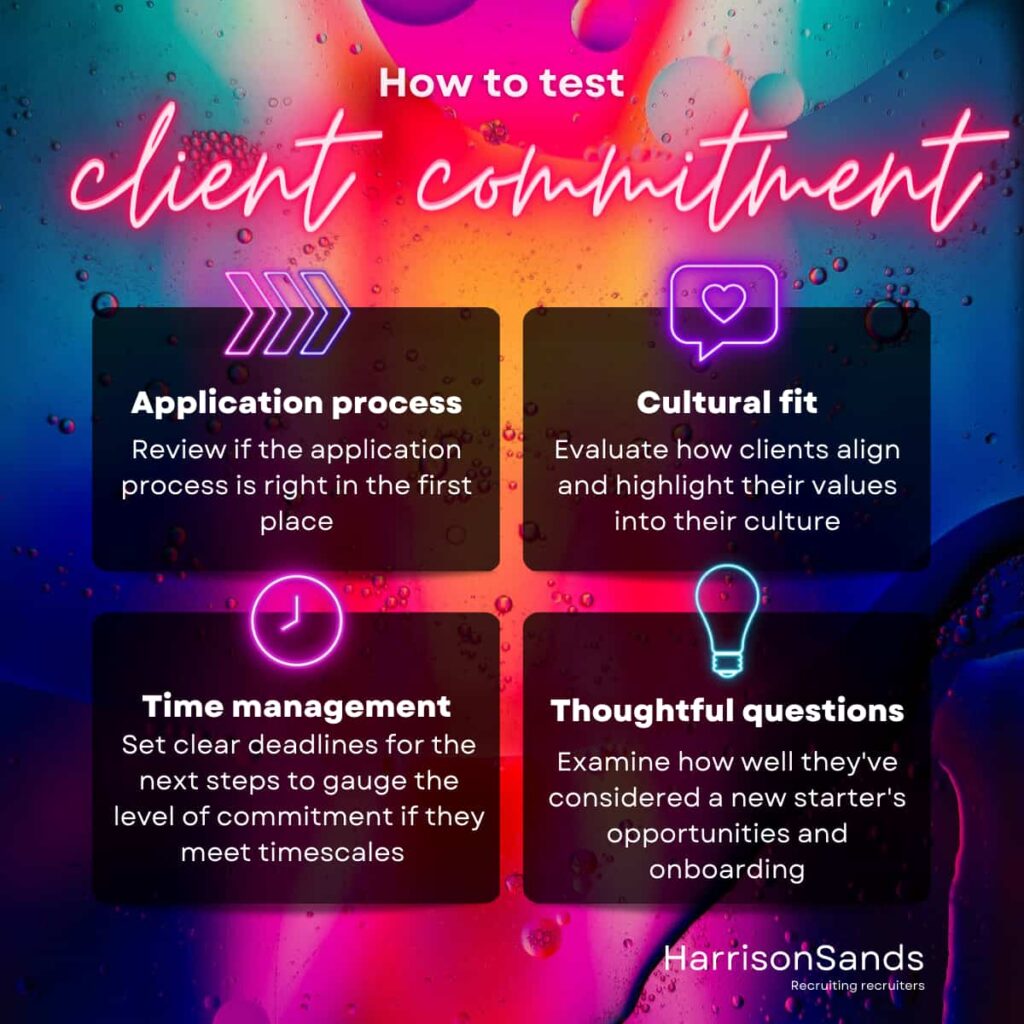
    🕑 Time Management – Observe how clients manage their time and respond to deadlines. For example, setting clear deadlines for the next steps in the hiring process and evaluating how when clients meet them can reveal their level of commitment. This is key to ensuring there is mutual investment from both parties, otherwise, it’s never going to end well.

    📝 Review the Application Process – Review whether their application process is fully effective and efficient in the first place. Understanding how they review CVs, how they structure their interviews, what their decision process look like etc are all aspects that you can consider determining if they have a well-thought-out process in place. Or whether you can make recommendations which they can consider to improve the efficiency.

    👥 Cultural Fit – Evaluate how clients align with company culture and values. Ask them what their culture looks like. Review how it’s represented in the job description. If they haven’t done any work on it and have no collateral on it, then that shows there’s an issue internally that needs resolving. 

    🔍 Thoughtful Questions – Ask thought-provoking questions to gauge client commitment. For example, asking how they see the team and structure developing or what the onboarding process looks like for new starters.

    🤝 Agreement Terms – Pay attention to what terms and conditions (if any) the client is asking for. Consider whether the agreement is balanced and fair for both parties and if there are any red flags.


    👍 Client Feedback – Ask for reviews or feedback from the client. Make sure the feedback is independent and credible so that you can see the true measure of their commitment.


    🎯 Align Expectations – Be upfront about expectations from the get-go and clarify key points on each side as often as needed. This will help keep everyone on the same page and ensure no misunderstandings occur.

    There are several questions you can ask a client to gain insight into their needs, expectations, and organisational culture.

    Here are some examples:

    • What are the key skills and attributes you are looking for in a candidate for this role?
    • How does this position fit into your organisation’s long-term goals and strategy?
    • What are the biggest challenges facing your company in the next year, and how do you see this position helping to address those challenges?
    • Can you describe your company culture and the qualities that make someone successful in your organisation?
    • What do you see as the biggest challenge or obstacle in filling this role?
    • How does your company handle diversity and inclusion, and what specific steps have you taken to ensure a diverse and inclusive workplace?
    • What are the most important values and principles that guide your organisation, and how do they translate into your hiring practices?
    • What are the growth opportunities and potential career paths for someone in this position?
    • How do you measure success in this role, and what metrics do you use to track progress?
    • What are some of the unique aspects of your company’s industry or market that a candidate for this role should be aware of?

    By testing client commitment, you can ensure that both parties are fully invested in the hiring process and increase the likelihood of a successful placement.

    Asking thoughtful questions and observing behaviour can reveal valuable insights into client commitment that can help recruiters make informed decisions.


    #RecruitingTips #Rec2Rec #ClientCommitment

  • How to control a conversation

    How to control a conversation

    As a recruiter it’s important to be able to control a conversation and get straight answers from candidates or clients to ensure that you have all the information you need to make informed decisions.

    HOWEVER. We know that sometimes everyone isn’t always forthcoming with things such as billings or their commission for example, and need a bit of work to drill down the root of an issue.

    Here are some tips on how to control a conversation and get straight answers:

    🗣️ Set the tone: Start the conversation by clearly stating your purpose and what you hope to accomplish in the conversation. Then, if you feel they’re skirting around a certain topic, be direct and ask something like ‘How do you know you were doing a good job?’ and take note of what they’re not saying.

    👂 Listen actively: Actively listen to what the other person is saying and ask follow-up questions to clarify any confusion or uncertainty. Use specific words they are using to mirror their tone.

    📝 Take notes: It might seem obvious but this is often overlooked. Take notes during the conversation can help you remember important details and ensure that you have all the information you need. You don’t want to overlook anything and need to go back to them. It’s not a good look.

    💬 Use open-ended questions: Use open-ended questions to encourage the other person to provide more detailed answers. For example, “Can you tell me more specific details about your experience with XYZ software?”

    💪 Be assertive: If the conversation starts to go off-topic or if the other person is being evasive, it’s important to be assertive and redirect the conversation back to the topic at hand. For example, “That’s interesting, but can we please get back to discussing your qualifications for the position?”

    🗣️ Speak in a conversational, respectful manner: It helps to stay on topic and maintain professionalism when speaking with someone. Avoid using aggressive language that could put the other person on the defensive or make them feel embarrassed or uncomfortable.

    👩‍⚖️ Acknowledge any points of disagreement: If there is an area where you both have different perspectives or are not seeing eye-to-eye, acknowledge it and move forward. Try to come to an agreement after discussing the issue, even if it’s just saying something like “Ok I see what you’re saying.”

    🗺 Set boundaries: Set limits on the amount of time that you will spend discussing a particular topic, and be clear about what topics are off-limits. This can help keep the conversation on track and ensure that your goals are met. For example “Unfortunately I can’t discuss the other candidates with you.”

    💬 Be curious: Ask questions that encourage meaningful dialogue and exploration, such as ‘What made you interested in XYZ?’ or ‘What do you think motivates people in this industry?’

    🔁 Exchange ideas: Try to create a two-way dialogue, instead of only asking questions – encourage the other person to share their own insights and experiences, which may provide you with valuable new perspectives.

    📝 Summarise: Summarise key points and decisions made at the end of the conversation to ensure that everyone is on the same page. This will also help you remember important details and be prepared for your next interaction.

    Remember to always approach the conversation with professionalism and respect. Be open to hearing different perspectives. But consider that there are times when you just need to walk away from someone if they’re not being open and honest with you.

  • Never be embarrassed to ask loads of questions

    Never be embarrassed to ask loads of questions

    Asking questions is one of the most important aspects of being a recruiter. Here’s why you should never be embarrassed to ask loads of questions and the sort of questions you can ask:

    🤝 Building Relationships – Asking questions helps build relationships with candidates and clients. By showing a genuine interest in their experience and goals, recruiters can establish trust and rapport.

    • Can you tell me more about your background and experience?
    • What motivates you in your career?
    • What are your long-term career goals?

    🧠 Gathering Information – Asking questions helps gather important information about the candidate’s skills, experience, and work preferences. This information can help identify the right fit for a position and make informed hiring decisions.

    • What are your top skills and strengths?
    • What kind of work environment do you thrive in?
    • Can you walk me through your previous work experience?

    👥 Understanding Needs – Asking questions helps understand the needs of both the candidate and the client. By asking the right questions, recruiters can ensure that both parties are aligned and committed to the hiring process.

    • What are the must-have qualifications for this role?
    • What are the top priorities for your team/department?
    • How do you measure success in this role?

    📈 Personal and Professional Growth – Asking questions helps recruiters grow personally and professionally. By seeking out new information and insights, recruiters can become more knowledgeable and effective in their role.

    • What skills or knowledge do you think are important for a recruiter to have?
    • Can you recommend any resources for professional development in recruiting?
    • How have you grown in your own career as a recruiter?

    🤔 Avoiding Assumptions – Asking questions helps avoid making assumptions about candidates and clients. By seeking clarification and understanding, recruiters can avoid misunderstandings and improve communication.

    • Can you clarify what you meant by [specific statement or detail]?
    • How do you prefer to communicate and stay in touch throughout the hiring process?
    • Are there any concerns or hesitations you have about this opportunity?

    By asking loads of questions, recruiters can build stronger relationships, gather important information, and avoid making assumptions. So never be embarrassed to ask questions – it’s an essential part of being a successful recruiter.


    #RecruitingTips #AskQuestions #BuildingRelationships

  • How to manage stress

    How to manage stress

    Let’s talk about a topic that we all can relate to: stress. It’s an inevitable part of life, but it’s important to manage it effectively. One of the main sources of stress in the workplace can be colleagues or managers.

    If you find that a colleague or manager is causing you undue stress, try having an informal conversation with them to address the issue. If that doesn’t work, don’t be afraid to escalate the issue to your line manager or HR department. It’s crucial to take action when your well-being is being impacted.

    In some cases, unfortunately, the employer may not accept or acknowledge that stress is being caused. In that situation, you need to prioritise your own health and well-being.

    Remember, your mental health is just as important as your physical health. If you’re not getting the support you need, then it may be time to consider leaving.

    It’s important to note that most companies do offer training to help managers spot signs of stress. However, everyone experiences stress differently. That’s why it’s crucial to take responsibility for your own mental health and SPEAK UP when you’re feeling overwhelmed.

    At the end of the day, unless you tell someone you’re stressed, they won’t know. (If only recruiters were mind readers hey..)

    So, our advice to you all is to be proactive in managing your stress levels. Here are some suggestions on how to manage your workload:

    📈 Metrics and Targets – Recruiters are often held to strict metrics and targets. This can lead to pressure and stress. To manage this, break down larger goals into smaller, achievable ones. Celebrate your wins, and don’t be too hard on yourself when you miss a target.

    📧 Communication – Communicating with candidates and hiring managers can be challenging, especially when there are misunderstandings or delays. To reduce stress, be transparent and honest with all parties. Set clear expectations and timelines for communication, and follow up regularly.

    💼 Heavy Workloads – Recruiters often have a lot on their plates. To manage heavy workloads, prioritise tasks and delegate when possible. Take breaks throughout the day and avoid working late into the night. It’s important to maintain a healthy work-life balance.

    👨‍💼 Difficult Candidates/Hiring Managers – Dealing with difficult candidates or hiring managers can be stressful. To manage these situations, remain calm and professional. Use active listening and empathise with the other person’s perspective. Seek support from colleagues or mentors if needed.


    Remember, stress is a normal part of life, but it’s important to manage it effectively. By implementing these tips, you can reduce stress levels and maintain a positive mindset, both in your personal and professional life.


    #RecruitingTips #SelfCare #StressManagement

  • How to know when it’s time to quit your job

    How to know when it’s time to quit your job

    Making the decision to leave your job can be a tough one, and it’s not something that should be taken lightly. However, there are certain signs that may indicate it’s time to move on to new opportunities.

    Here are 10 things to help you consider if you’re in the right role or if it’s time to move on.

    1.         Time: Have you been in the same role for a long time without any significant changes or opportunities for growth? If you feel stuck in your role and you’re not seeing any opportunities for advancement, it may be time to look elsewhere.

    2.         Salary: Are you being paid fairly for your skills and experience? Have you received a raise or promotion recently? If you feel undervalued and underpaid, it’s important to speak with your management team to see if they can address your concerns. If they’re unable to do so, it may be time to consider other options.

    3.         Colleagues: Do you enjoy working with your colleagues? Are you part of a positive team culture? If you’re not happy with the people you’re working with or the work environment, it can be difficult to feel motivated and engaged in your role.

    4.         Leadership: Do you feel supported and valued by your management team? Are they providing you with the resources you need to succeed? If you’re not receiving the support you need to grow and develop in your role, this is one area of concern that should be a red flag for you. A supportive line manager is essential for your professional growth.

    5.         Company: Is the company aligned with your values and beliefs? Do you see a future with the organisation? This aspect is becoming more and more important. People like to work for companies that align with their values. A toxic workplace generally won’t change, so make sure you’re somewhere you’re proud to be.

    6.         Workload: Are you feeling overwhelmed and overworked? If you’re consistently working long hours or feeling stressed and burnt out, it may be time to reassess whether your workload is sustainable. This may involve discussing with your manager to see if there are ways to reduce your workload or delegate tasks.

    7.         Professional development: Are you receiving opportunities to learn and develop professionally? If you’re not being given the chance to develop new skills or take on new challenges, it may be time to consider a change. Look for companies or roles that prioritise professional development and growth opportunities.

    8.         Job satisfaction: Are you genuinely enjoying your work and finding it fulfilling? If you’re feeling unfulfilled or bored with your current role, it may be time to explore other options that align with your interests and passions.

    9.         Company stability: Is the company stable and secure, or are there signs of financial trouble or instability? If you’re concerned about the future of the company or your job security, it may be wise to start exploring other opportunities before it’s too late.

    10.   Work-life balance: Are you able to maintain a healthy work-life balance? If your job is taking up too much of your time and you’re not able to maintain a healthy balance between work and personal life, it may be time to reassess whether the job is the right fit for you.


    Remember, deciding to leave a job is a big decision that shouldn’t be made hastily. Take the time to assess your situation and make an informed decision that aligns with your personal and professional goals.

    Making the decision to leave your job can be tough, but sometimes it’s necessary for personal and professional growth. As a recruiter, we’re here to help you navigate your career path and find the perfect opportunity. Let’s chat! 💬


    #recruitment #careeradvice #jobsearch


  • Top reasons to move from a corporate recruitment company to an SME

    Top reasons to move from a corporate recruitment company to an SME

    Recruiters know the importance of finding the right role at the right company otherwise a new job can just be a huge waste of time for everyone involved.

    Corporate recruitment companies might be the initial go-to for recruiters looking for a new role, however, they’re not necessarily the most beneficial for career development, personal development, or overall progression. Working at a larger organisation might mean good initial training and national accounts to leverage off, but it’s the longer-term aspects of an SME which will ultimately pay off.

    Well, we’re here to tell you why it’s better to be a big fish in a small pond rather than a small fish in a big pond! Take a look at our top reasons to work in an SME recruitment company below.

    1. Better commission schemes
      Commission structures are always one of those things that will be one of the main motivators for a lot of recruiters. SMEs can offer a better commission scheme as they aren’t tied down to a standard percentage structure like a lot of the larger corporate firms are.
    2. Better salaries
      SMEs aren’t bound by pay sales and appreciate a recruiter’s experience and potential when looking at their salaries and annual increases.
    3. Bespoke incentives
      Trips away, exciting events, meals out, socials or spin the wheel surprises… the list of bespoke incentives can very company to company but generally SMEs are more likely to provide fantastic incentives to nurture their teams whereas a larger company might only provide smaller perks.
    4. You’re not just a number, you’re classed as a person
      When working in a smaller team, you’re much more likely to be seen, valued, and heard. And with that comes better working relationships.
    5. You have more opportunity to share ideas and shape a business
      More quality time with your co-workers means more time to understand what makes the business tick and the insight into what you think could work better. Larger companies will only include certain people in that decision making, whereas in an SME you will have many opportunities to discuss different ways of working and actually be heard.
    6. Less bureaucracy decisions can be made quicker
      Work politics stressing you out? There can be lots of different systems and processes in place in a large organisation that can be frustrating to work around. Sometimes even the most straight forward of issues can take a while to resolve. If you’re looking to work somewhere that empowers people whilst they get stuff done quickly, then SMEs are keen to nurture their staff and are generally much more solution orientated.
    7. Entrepreneurial spirit is encouraged rather than being slow and clunky
      If you’ve got a good idea – let’s discuss it, try it, then review. SMEs are open to new ideas and new ways of working – they don’t shy away from them. Chances are, they have grown thanks to ambitious, forward-thinking people which appreciate and value new ways of thinking and want to embrace likeminded people.
    8. More often than not it’s quicker to get promoted
      When you have more time with your line manager and a clear progression plan, you’re more likely to have fast-track career development in an SME where they will be able to truly focus on your growth. Larger organisations often already fill all available roles from lower to senior level and so progression is often limited.
    9. More flexibility
      Flexible ways of working are now the preferred option and many organisations, large or small, will offer this. However, do you want to swap the day in the office for the one at home this week because your dog stepped on a bee? That next level of flexibility is often hard to come by in a larger organisation as everyone has to adhere to the same rules. One the other hand, a smaller organisation will be understanding of everyone’s individual circumstance which creates a more accommodating and understanding way of working.
    10. You have more autonomy
      If you don’t want to be micromanaged, great managers in SMEs will support you in being independent and letting you thrive!

    If you’re looking to make a move – get in touch with our recruiters who are experts in finding the right recruitment role for you, in complete confidence.

  • How to PROPERLY research for a recruitment interview

    How to PROPERLY research for a recruitment interview

    You’ve got a job interview… congrats!!!!

    It’s a great company, a better salary and you’ll be in line for a promotion within 12 months – in short you want to smash your interview and get that job!

    You’re making sure you’re prepared, booked the morning off from work, planned what train you’re getting, spent extra time on your hair, and picked your most impressive ‘smart casual workwear’. But, have you done the most important thing…. RESEARCHED THE COMPANY YOU’RE INTERVIEWING WITH?

    Spoiler alert, this does not mean a quick look at their website on your journey to the interview!

    As we’re entering a more competitive job market, it’s almost a guarantee that the best researched and presented person will get the job. With this in mind, we have put together some handy hints on what to research and what resources you can use:

    LinkedIn
    Make sure you’ve viewed and read the profile of who is interviewing you as well as any members of the senior management team and the company page itself on LinkedIn. It’s a great way to understand the background of the team and also any up-to-date activities the company is talking about e.g. new business wins, article sharing, and charity activity or events.

    The company website
    Not just the About Us page, make sure you’ve viewed the latest blog and are able to use the information on the website to answer the question ‘what can you tell us about the services we provide’. Also, don’t forget the Vision and Values page, as most likely the interview questions you’ll be asked will focus on how you demonstrate these – cultural fit is key!!

    The company’s recent job adverts
    This will tell you the typical job titles and salaries they recruit for and the volume of vacancies they have.

    Who are their main competitors?
    The best way to research this is by Googling the job titles and locations which they are advertising and finding out what other agencies have similar adverts running.

    Companies House
    This is especially relevant when you are interviewing for a non-entry-level role! You can find out about the directors, company financials, etc.

    Social media
    Most companies have an Instagram or Facebook page, some are more active than others, if a company is posting regularly it’s a fantastic way to learn about their culture!


    It’s going to take you a bit of time to do this research well, but realistically all of this can be done in half an hour, time well spent when it means you’ll secure your dream job! Good luck!